Showing posts with label knit. Show all posts

Thursday, 10 March 2016

UCA symposium and Dorothy Caldwell - A course at the Royal School of Needlework

This was a treat. In the same week two related great textile events. The University of the Creative Arts, hosted through the Crafts Study Centre in Farnham, organised a symposium on damage and repair, entitled 'What do I do to make it OK?'. This was a symposium that followed an exhibition of the same name with a number of exhibitors who also spoke on the day. And then at the weekend Dorothy Caldwell taught a class at the Royal School of Needlework, I guess as she was already over here to show some of her work at the exhibition and to attend the symposium.

Symposium: What do I do to make it OK? 

This event consisted of a number of quite different talks by different types of presenters: academics, artists, makers, researchers and community artists. The idea of damage and repair was interpreted quite widely from broken communities, repairing the soul, to more literal meaning of repair through mending. 

The first keynote speaker was Bouke de Vries. A high end artist with an interesting background in fashion and ceramics conservation and now working in sculpture. He showed a lot of his work in a chronology of his development as a maker, including works based on the Dutch still life genre and some quite humourous pieces, including a Marge Simpson as a Madonna with a number smaller Simpsons at her side. This was one of the better talks and others that stood out for me were: a talk by a community artist (Claire wellesley-Smith, author of 'Slow Stitch'), whose challenge in a deprived area of Bradford was tangible, a talk by Celia Pym on repairing stuff in a dissecting room, a presentation by Fredie Robins on her knitted work, which included some repaired by Celia Pym, and a great talk at a time when energy levels were short, on women's memories of repairing, mending and the tools of sewing, including button boxes and darning mushrooms.

I was really happy to have attended this event. It is rare to get a whole day of such good speakers. I would have preferred that they had had fewer speakers and given people longer time to speak. There were some talks that were poorly targeted at the audience, and others that needed to have practiced beforehand, and at 20 minutes for each some of the talks whizzed through. There was a lot to think about and wonder at, and you sometimes questioned what might come next for some of these artists. 

The exhibition was also quite stimulating. There were examples of Pym's work with repaired socks hanging on the wall, some of Caldwell's smaller pieces and other works using, for example found objects and juxtaposing them with natural materials such as shiny silvery packaging for tights from which dried grasses were suspended, drawings and other works.

Royal School of Needlework: Dorothy Caldwell

The Canadian artist, Dorothy Caldwell, is a well-known name in the world of quilting. I saw her work a few years ago at the Festival of Quilts. Her background is originally in fine art, in painting and print making, and she works with her textiles in a painterly way, thinking carefully about materials, how fabrics are composed and asembled and moving beyond the quilt, to works on paper. She is interested in textiles from daily life, the simple stitching made by ordinary women as they create the materials stuff of everyday life. The course was based on her considerations of kantha quilting and she gave us a talk of a study visit she had made to India looking at the application of this technique, as well as showing her own work.


Here Dorothy is showing a kantha quilt she has brought back from India. She was considering the iconography of the work, how stitching was used and the way the women's co-operative used the kantha tradition to tell meaningful stories for the women in the present.
She laid out some of her work and sketchbooks for us to look at, and to learn from her processes. This was quite interesting, to touch someone else's process and see how she experiments with materials and tools.

The course consisted in a few short drawing exercises, including drawing marks based on sounds gathered in the grounds of Hampton Court and drawing lines and impressions from walking and observation.


I picked up all manner of sounds including planes overhead, birdsong, people talking, swans and crows squawking and crunching pebbles underfoot. There was a very keen robin sitting on top of the topiary and I managed to zoom in on him after my drawing exercise.

We were provided with a pack of materials and thread and given some drawing paper to use. Above you can see some of the sound-marks I recorded using pen and charcoal.


Here you see the work in progress, a sample with couched thread, the drawing and some of the threads I used.

Overall this was a very useful course to inspire further work. Dorothy suggested we were doing a five day course in a single day, and I am guessing that if spread out, having more time to think and to prepare various stages we might have had time to finish things and to experiment further. As it is the course was a useful trigger for thinking about next steps.

Dorothy Caldwell's work considers the landscape and the materials in it. I find it interesting  that the combination of the thought pattern concerned with ethnic traditions in making with a concern with the stuff of the landscape (marks, colours, earth) creates her unique artistic language. 

I think it it worth remembering that we can use references in all manner if different ways, not just a literal reinterpretation, but let the idea of some of the sources be channelled through experimental work, drawing and working out of ideas that concern us. I would like to think about that a bit more. When I see certain textile artists with good ideas, that are then repeated over several years in almost the same way I wonder about renewal of work, how one develops and grows and shifts. To bring this thought back to Bouke de Vries' talk: what he showed was that there is always something new to explore, interesting sources to work out, and that even one's training need not be limited but can be built on and re-generated.

Friday, 1 January 2016

Some changes and new books

As mentioned elsewehere, the last two months have been spent studying and working towards an exam, but once all of that was over I very soon moved into a studio I have rented to help take the pressure of storage off the house and to allow me to go to a dedicated space for working on textiles. I think this will help develop creative work in a more focussed way, as the home environment has its own distractions.

This studio is now being filled with equipment, wool and fabrics, craft items, beads and threads. It is all very exciting and I have started weaving there to see what it would be like working there. I almost immediately installed a radio as sitting alone in a room in a fairly isolated place is a bit empty, and so now I can listen to great music and audio books as I work - it is great.

Here are some pictures from the studio, a corner with some of the furniture - opposite this, out of sight is the table I am working at, ths is where I put out wools and fabric and sewing machine. The corner here is where the wool is stored and where a few books and craft materials have been placed:


I hung up some pictures of woodland and a drawing to help me work our how to place some textile for a books cover.

The clothes horse holds some skeins of wools and linen from various dyeing projects, thatare waiting to be wound into balls. Not my favourite project so I do a few at a time to get through them.

 
Some work in progress on the table - more about that on the theme book post.


Christmas - presents!


It has also been Christmas and I wanted to mention that here, as I got all the books I wished for this year - the latest books by Kate Atkinson and Margaret Attwood, two of my favourite authors, and a book on knitting by Carol Brown. 'Knitwear Design' is a book that reads as if the target audience is a knitwear fashion student. It has a lot of good-sized pictures, with short text pasages in sections themed on colour, texture, various knitting techniques, using a sketchbook for designing and so on. It is a useful short-hand to the design process as proposed by art colleges, but it also shows that despite the process prescribed by such writers and schools of textiles, the actual designers such as Sandra Backlund, will design experimentally directly on the figure. The book does not explain whether these designers also draw, but describe their design process as making up costumes and fashion items of fantastic ingenuity and creativity as committed to samples and testing experiments in situ. I guess designing is a bit like learning to cook - there are a lot of rules, recipes and certain things cooks will prescribe, but once set free in the kitchen, you actually just do what you need to do to satisfy your own free thinking.

For more details See Carol Brown, Knitwear Design, Laurence King, 2013


Tuesday, 25 August 2015

An interlude - a dyeing (experiment) project

It is that time of year again - the blackberries are out and I decided to go picking on a quiet Sunday. I have this absolutely beautiful yarn of a singles DK Wensleydale wool - I believe I have praised the qualities of Wensleydale wool before, but here it is - it is smooth, is lustrous and there is enough for a jumper (900g):


The plan was to dye two lots of 300g in solutions of berry dye, to get two different shades of a purple colour, and then dye the last 300g in the colour derived from leaves of the bramble plant. I picked a large volume of berries, and focused on snipping the fresh shoots from the plant. The yarn was prepared in an Alum (8%) and cream of tartar (7%) mordant - here it is soaking before it went into the dye bath:


Here the berries are being cooked to draw out the juice for the dye:


Here the leaves and shoots are soaking prior to being cooked up to get the most of the dye:


And what results did I get out of it? Well, I had a bit of a disaster with one of the dye baths. The colour was a bit insipid and I found a blog where someone suggested she had tried to change the PH of the dye-bath to change the colour by using washing soda, so I poured some in, and the colour changed so dramatically that I had to pour it out almost immediately to prevent the yarn from getting too dark a grey colour, and then poured some left-over fruit juice into that bath to re-gain the purple tones. I then also read on Jenny Dean's blog, Wild Colour, that one should not add washing soda to wools in warm water as it breaks down the fibre, so I had to rinse the wool in huge volumes of water to try to get it all out. I do hope it will be OK.

Anyway, in the end I have two tones of grey-purple, and the silk fabric I added has also taken the colour fairly well:


On other blogs I had seen that the leaves of brambles would dye wool a pale green. This would be a perfect complement to the purple, so I had high hopes for the leafy dye-bath. However the colour that came out of it was a bright yellow - at least on the wool fabric I dyed. The wool and mohair yarns also took the yellow, but is slightly paler. Unfortunately the photograph does not show how yellow it has all become.

I am now contemplating doing an indigo over-dye on the fabric, as the yellow is not good for making garments of, if I was to wear it myself:


Wool fabric, fine tightly spun mohair and wool yarn.

Sunday, 22 February 2015

A fair, a talk, some wool and a bit of spinning

Unravel - a the knitting fair

Yesterday I went to Unravel at the Farnham Maltings with a friend form my Guild. They have this annual knitting event with a lot of stalls selling wool and accessories, a few courses and talks.

It is a full day, your senses are overloaded and when you first arrive you walk around in a sort of trance, picking up wool here, gazing at colours there and trying to see everything all at once, through the many, many people who are all there, doing the same thing.

So, we walked through the great hall first. Stopped at length at the John Arbon stall as he had a lot of fibre there this year, and you can usually grab some sort of bargain if you root around the offers in a large tub to the side. He had some very good fibre on show, superwash wensleydale was my favourite - in fact gotland and wensleydale wool are by far my all-shining fibre favourites at the moment - loose locks (both), a strong hairy fibre (wensleydale), and they can have the most beautiful silvery greys. It was great. I got some bags from the big tub, and we went on our way through the hall.....

The wool

And what was next - well, there was the Little Grey Sheep stall with bags of gotland fleece just waiting to be felt and adored. I bought 1 kg of this fleece - extravagant I know, but I already have a spinning project on the go with grey wensleydale so this will fit very well with that in the ply. 

There is just so much stuff at Unravel, and you can get a bit carried away. Room after room of dyed yarn. I have to say I find quite a number of the stalls are repetitive, there is only little variation on the theme of dyed yarn, but luckily there are also stalls with buttons, some with vintage woollen mill items and rug wool, and some with natural wools waiting to be dyed. And that was where Texere fitted in - they had the most beautiful singles wensley dale wool in large hanks - so there is the theme again, the strong yarn with a great soft lustre. I went back there in the afternoon and bought around 1 kg of that too!

For lunch we went into Farnham via the New Ashgate Gallery of craft. It is a fine little gallery with some good things, a bit of jewellery, ceramics, prints and paintings. There were some Barry Stedman pots there so I got to see what his chunky work is like, and some nice glass things.

After lunch we went to the Craft Study Centre to see the historical exhibition of students' work, FARNHAM TEXTILES 1949-2015: Celebrating sixty-six years, which was a mixture of books showing systematic approaches to dyeing with synthetic dyes and small displays of finished items, including a lace shawl that was in the most intricate work I have seen in a long time. There was also a pleated and heat-set scarf in the manner of Reiko Sudo (might have been hers, but I didn't check the list and there was no label) - good to see in reality what you otherwise see in photos.

A talk

.......Then back to the Maltings to buy more stuff - shawl pins and that wonderful wool at Texere, and then on to sit in on a lecture by Alison Ellen, the knitwear designer. This was an inspiring talk - on how she works with colour in her design. She really only covered those basic techniques that have been tested in assignment 2 of the course, but here it was shown in practice. If I take a couple of things from the talk that I will think about more in my own work it is her treatment of colour proportions derived from photographs, say, using a theme (her examples included green, but she also covered reds in another image) - and sampling using first simple stitches and then gradually working up more samples to play with the idea. Her language also showed how reflective she is about her work. She used the term 'cloth' about the knitted fabric. OK, that may sound obvious, but when I have been making knitted garments, I use the word 'knitting' about it, or a 'knitted' thing, but that slight inflection of the word changes things I think. knitting is a cloth-making process and by showing how it makes a fabric, a certain value is giving to it that elevates it and gives it a certain value. She also spoke about using rhythm and repeat in her colour designs, and thinking about slight variations derived in the dyeing process as 'syncopations'. Again that musical reference, but an interesting dimension to thinking about the work of what design can do. Alison Ellen is a true craftsperson and I think her designs for hand knitted garments are of a quality rare in the knitwear world.

And a bit of spinning

Obviously with such a full day there was not a lot of time to rest when I got home. However I knew what was in those bags and I wanted to bond with some of it straightaway. The wensleydale yarn was washed and hung to dry in preparation for dyeing some day. It is a very strong yarn and has a heavy body to it - I suspect it will hang well. It deserves a special pattern so that project is still to come. But as I alluded to I have some dark gotland lambswool on my spinningwheel destined for a project with some paler wensleydale, so I pulled out the darker strands of the new fleece and am now spinning it into the lambswool with some interesting green-black silk to create a bit of interest - a very slow project done on the side or when I have a moment of longing for spinning. Oh, it is a delight to spin a beautiful fleece - I spin from the grease (i.e. unwashed with the lanolin still in) or from commercially prepared rovings (I don't care too much for carding, there is just not the time and it is one preparation step that industry has made so much lighter). I don't mind the slight odour of urine and sheep, in fact I find it  comforting - it is almost the closest I can get to the nature of the animal without rearing it, and that is a gift from nature in the process of making.

Monday, 20 October 2014

Intervals

Well now, one may ask - why haven't I been able much textile work recently? In fact, apart from what I describe on a previous blog on visits to London, and stash building exercise buying fleece, yarn and dye recently (October), I have not actually been able to get into making for the course in the last 4 weeks.

My work has been very busy, I get home tired, and then we had a new kitchen built, which means that the house has been in upheaval when I got home. Really not conducive to then sit down and concentrate on the course.

A shame, as I have plenty of ideas, have decided to look at trees in some way for the final assignment and project 7, and so will try to look at sampling along this theme as well in my steps towards that final assignment on this course.

I did do some dyeing of wool, using autumn berries, black and elder berries. I got a variety of colours and have been knitting a waistcoat on an Alison Ellen pattern, which is coming along fine, just a small thing to get on with when you are tired, sitting watching TV and not having to think too hard. OK, I also think that knitting is a kind of short-cut, a way of making something nice and comforting in a direct way, and it fills a hole where my design work should be.

Here is a detail showing the colours:


The picture does not really do the colours justice, but the rosy pinks are the elderberry dye, the purple tones blackberry. The exhaust gave greys with a tiny bit of iron modifier (the blue is some contrasting commercial yarn which I did not dye). Quite satisfying. The waistcoat was completed in November, but I continued to find it difficult to get into things. Thankfully with the Christmas break I had a chance to catch up and have now got into making samples again.


Visits and exhibitions - October

Here in October the Knitting and Stitching show has been on at the Alexandra Palace. I have been a couple of times before, but this year I went twice - a glutton for punishment one may say, as I went on Friday (10th), and then on Saturday (11th), one of the busiest days.

Anyway, my friend and I went on the Friday for fun, to see what was new and interesting - we started by looking at the exhibition area, including the student awards. There were some fine textured knits I found quite good, and I think the International Feltmakers Association showed some very strong things. Ecoprinting, one of the latest trends in creative textiles it seems, was also shown on a commercial stand, and yes, there the usual suspects were, Jan Beaney and other creative tutors and suppliers of materials. Coats had a large stand dedicated to Rowan yarns and patterns and there were many, many smaller suppliers of all things textiley and equipment based.

What did I buy? well I had planned a visit to Oliver Twists to get some silk bricks for spinning with some mohair and Wensleydale fleece I have, and got a couple of fine green ones; I also splashed out on a pack of Markal paint sticks. To have a rest in the afternoon we decided to sit in on the fashion show. This was actually disappointing. Rowan showed garments from its latest pattern books, and so did other Coats brands such as Patons, but there was nothing really outstanding in the show. One might have thought that a fashion show would have pulled out all the best or most extravagant garments to show what can be done, stretching boundaries of technique or experiments in colour; instead there were uninspiring plain jumpers, the odd good Fairisle cardigan and a run of ponchos designed on a South American theme - presented to promote a particular stand somewhere in the sea of stall of the large hall.

On Saturday, when most tickets had been sold out and the crowds were thick in the aisles of the shopping hall, I went to volunteer in the British Tapestry Group's stand, which had an exhibition of professional and amateur pieces made by the Group's members, and curated by Hillu Liebelt. This was good, I met a Swedish weaver, Lis Korsgren, who had a piece showing. I had a chat with Lis about her construction method which is derived from Helena Hernmarck's work. The work is semi-representational but looks abstract close up. Her work in the show was a blue and white hanging showing tractor tracks in snow, using different densities of yarn in the weft I thought that was quite interesting, since it is made on a cloth weaving loom rather than a tapestry loom and stimulates questions of technique and visual representation.

I have to say I have mixed feelings now about the Knitting and Stitching show. It is a very good opportunity to see some current work, however the show is dominated by shopping and the craft consumerism of a huge textile-based shopping mall. There are of course many gems, I like that Slow Loris is there showing and selling exquisite work made by Chinese tribal people, it is good that smaller sellers are able to show their work and one can peruse this physically rather than looking at tiny photos on the web. However I know from experience, and from having spoken with a number of people who also visit these events, that what one takes away from the show in many cases ends up as stash, and bulky stuff at home in the work room rather something made, and that defeats the object of the making that the notion of craft is all about.

Anyway, the reason I say this is that I had been to see the Anselm Kiefer exhibition at the Royal Academy on the Thursday (9th) before, and it struck me on reflection, that I personally do not feel uplifted in a profound  way after a large crowded sales fair (whether textiles based or otherwise) as I do having experienced a great and immersive exhibition such as that on Anselm Kiefer. There were such fantastic paintings there, huge canvasses boldly covered in thick paints, ash, clay and material objects, including natural bits of sunflowers, branches and long strands of grass or reed. The exhibition was curated following a chronological line, his early work quite explicitly narrative somehow, recording and speaking of his early reactions to post-war German history, whilst the later works were grand statements more subtle in expression, despite their scale and monumental statements. He is clearly interested in certain poets and language, German landscape and forests, the materiality of the stuff he uses to build up his work. He uses words on the surface of pieces, sometimes words, at other times sentences.

To be honest I knew very little about Kiefer before I went. I vaguely knew he was important,  but I was very glad I went and saw so many poetic and finely telling pieces. Art historically there were references to Caspar David Friedrich, van Gogh and Joseph Beuys; there were nudes in large books and large installations of stuff - a mound of canvasses - the room smelling of oil paints, script on the wall. Clearly Kiefer has become quite wealthy in his later years, in recent years buying lead roofs off cathedrals and inserting diamonds into large textured lead surfaces - although modest seeming, maybe not as humble as one might have hoped during a time when those with less might think twice even going into a paying exhibition such as this one. But then that shows where my cultural capital lies, in placing a socio-cultural reading on this work when clearly the aesthetics seemed to be a priority (in the case of the diamonds and lead, a matter of alchemical processes). So, despite feeling that there was a flaw in this later work, I still loved the large landscapes of grasses, some with gold leaf, giant grasses swaying in the wind with golden sheaves of grass or reed pasted on to thick encrustations of paint. And carefully placed balances that seemed to weigh something heavy - time passing? Nature? the land?

In contrast to what these grand statements about nature, a sense of German-ness and art historical bonds evoked as I walked through the halls of the Royal Academy, a virgin spectator of this somehow romantic work by Kiefer, the days at the Knitting and Stitching show had vanishingly little to offer in speaking to something more than the somewhat consumerist aspects of contemporary textile crafts. Am I comparing apples and pears? well maybe, but I can't help thinking that if I want my work to sing it is by visiting the ideas of artists that inspiration will come, not so much from gathering overwhelming masses of stuff - the solitary reflection of ideas rather than the sensory overload of the crowded shopping hall...... However there is something fun about shopping that you can't completely ignore.

Wednesday, 13 August 2014

Other things done on the side

Alongside the course work shown here, I do a bit of work on the side. The course takes up a lot of time, so there is little time to create much, but I have been knitting and dyeing on the side.

Over the summer I dyed in rhubarb - this gave different shades of yellow-green, and I also modified a skein in iron, and over-dyed some in indigo.

Pictures to follow.


The local Guild of Weavers, Spinners and Dyers, which I am a member of, had a dyeing day and I had an opportunity to dip a shibori-style tie dyed pashmina in indigo. The ties where a poly cotton around pebbles of stone, and the square resist areas are unplanned, I did not foresee that these areas would be square like this, all I did was select stones in approximately the same sizes and tie thread around them. I am now wondering whether I should embellish this in some way. The pashmina was white with a subtle woven pattern which was brought out by the dye. This means the tie-dye clashes slightly with the weave and I think this clash needs to be brought out/harmonized further by embellishment....
this is still to come.


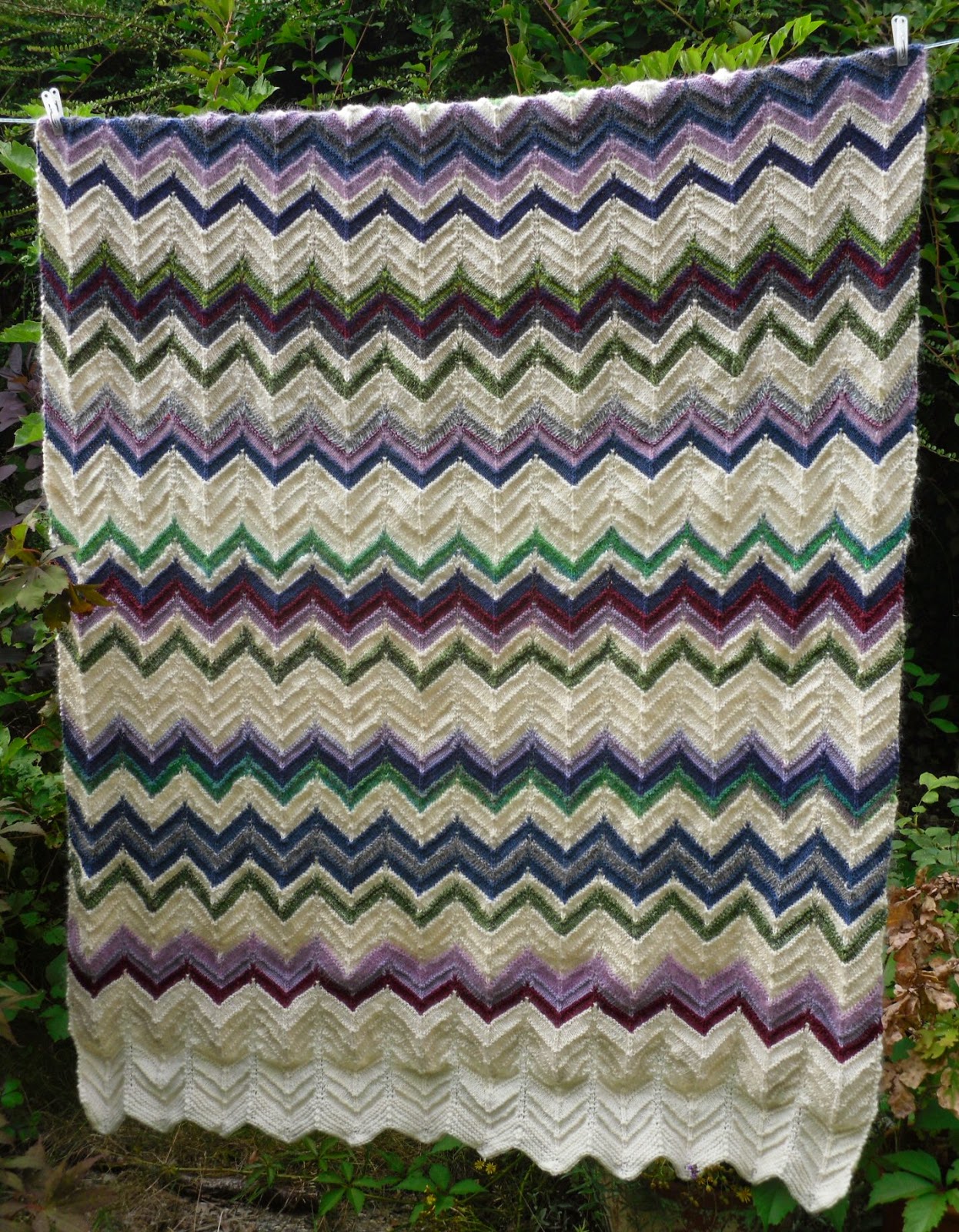
I finished a knitted blanket this week (19.08.14) which has taken a number of months to finish, using hand spun, commercial yarns, some dyed others natural. Some of the handspun is thinner than others and I used a steady needle size throughout - around 3.75, so it is quite dense in places and thin in others. There is handspun yarns acid dyed, dyed yarns using Koolaid, some commercial coloured yarn, but I guess around 60% or so is handspun. I did not spin it all, some came from table top sales with my guild and sales of leftovers by people who were having a clear-out.

The pattern is a simple zigzag stripe. I tried to spread the colours evenly across the blanket so there were no clusters of say, pink or green. It seems to have worked all right, the things is very heavy due to the denseness of the yarn and its size; although I haven't measured it, it must be around 2 m long as it is longer than I am. Folded up it will take up a fair bit of space, so it will take up a fair bit of space in my work room where I am planning to use it in the winter.