Showing posts with label dyeing. Show all posts

Sunday, 8 May 2016

Dyeing and more preparation

So, you could say that instead of making I have been diverted into preparing. Whilst tidying up I came across a bunch of cold water dyes that were just waiting to be used. And, having bought a bundle of sheets and having also found some nettle yarn I bought some time ago, I have over the last 6 weeks or so been dyeing all manner of fibres (but just not wool).

I am here just showing a small collection of fibre and fabric that is now ready for using in some interesting projects (the light on our kitchen is a bit bright, so the colours are over-exposed, in reality they are richer than is visible here):


This is mainly nettle yarn, coarse linen and some fine viscose weaving yarn. The dominant colour here is a rusty red.


Here is some more nettle yarn, but also some very shiny rayon croche yarn. I was also given a linen table cloth with lace corners from Denmark. Unfortunately I am not sure about the turqoise colour I gave it, so I am hoping that another colour will come along and I can over-dye it to cool down the brightness.


And finally from this batch: some hessian, silk, cotton fabric and cheesecloth, as well as cotton perle croche yarn. The dye works on all these different fibres, mainly cellulose, but for some reason silk also takes the dye well. Although you may think I only dyed a couple of baths, there are also greens, blues, yellows, oranges and reds in my stash now. I think these dyes are really very good - you can over-dye and changes hues, make bold, true colours on white bases or add fabrics/fibres later in the immersion to make paler notes, which is handy, especially if you want to make a set of different toned threads for a particular project. 

Here are some more fabric pieces in linen damask, cotton and a cotton-linen mix:


The tones were pale blues (the dye was called Moon Blue) - this was a very nice colour, it has a certain luminosity and lightness and will be good without too much layering of stuff.

Although the next picture shows greens, it does not do justice to the variety of fairly solid deep greens on cotton and linen threads:


There was also an orange coloured dye (Mandarin) that was so much sharper than I thought it would be. It worked well on cotton and will be useful in small amounts for bringing interest and focus to pieces: 


There are no longer any obvious dye pots lying in wait in a box somewhere, and so there is unlikely to be any diversions in that direction for a while. In fact, my landlady at the studio sold me some amazing large pieces of canvas she had dyed, which I want to do some applique and embroidery on, so now it is time to do some designing and thinking about making. I am planning to use some of these dyed pieces as part of that work.

I have also been preparing knitted fabrics for sampling for other projects. I got this knitting machine and have had trouble understanding how to cast on, but eventually I discovered, when reading the manual again, that I had placed the needles in the wrong position(!) - Once you do get started the knitting progresses very quickly which delights my impatient side. Soon it will be time to start working on this knitting, I am quite looking forward to that stage.

In the end I guess all this preparation will be good for something - it is the basis for the work to come, weaving felting and embroidery. Alongside this I continue to go to West Dean and there has been some encouraging feedback from tutors there that has made me think of what I am doing, how the work is expressed and what I may do in the longer term. I am glad I am doing that diploma, although quite precious it is a treat and helpful - speaking to other students can be quite enlightening and give helpful pointers. For example, I went on a drawing day and someone there was finishing her diploma; she had brought in her portfolio of work fro the full set of courses she had done. She was already trained in art, so her work was very good, but she was also a teacher and asked perceptive questions and gave pointers in discussions - helpful and interesting, stimulating to learn in this way.

Sunday, 7 February 2016

Diversions

I had a bit of a dyeing day today. It was a nice day, and I had intended to go to the studio, but then I started one dye bath, and then another, and before you know it, there were three dye-baths going on.

First there were a couple of yellow acid dye baths. I put a variety of yarns in there, some blue to get green, some rosy pink to get orange, some beige and some natural wools.

Here is the range, various oranges, lemon and other yellows and the greens. The picture doesn't do the colours justice, they are in fact a lot stronger than is shown here.

Another dye bath was a violet cold water dye. This is obviously for cellulose fibre, so I dyed some linen and cottons.


This photograph does not show the colours properly. But basically there are various shades of violet, and some very pale yarns. I also included some natural coloured flax which didn't pick up the dye very well.

A finally I used a vintage Dylon universal dye to dye both cellulose and protein fibres, a bright turquoise.


Overall a productive day. My head was buzzing with plans for project including using some yarns in felt making, using discharge dyeing and embroidery on this old nightie I dyed turquoise and so on - lots of ideas just bursting to get out into the fibre.

Tuesday, 25 August 2015

An interlude - a dyeing (experiment) project

It is that time of year again - the blackberries are out and I decided to go picking on a quiet Sunday. I have this absolutely beautiful yarn of a singles DK Wensleydale wool - I believe I have praised the qualities of Wensleydale wool before, but here it is - it is smooth, is lustrous and there is enough for a jumper (900g):


The plan was to dye two lots of 300g in solutions of berry dye, to get two different shades of a purple colour, and then dye the last 300g in the colour derived from leaves of the bramble plant. I picked a large volume of berries, and focused on snipping the fresh shoots from the plant. The yarn was prepared in an Alum (8%) and cream of tartar (7%) mordant - here it is soaking before it went into the dye bath:


Here the berries are being cooked to draw out the juice for the dye:


Here the leaves and shoots are soaking prior to being cooked up to get the most of the dye:


And what results did I get out of it? Well, I had a bit of a disaster with one of the dye baths. The colour was a bit insipid and I found a blog where someone suggested she had tried to change the PH of the dye-bath to change the colour by using washing soda, so I poured some in, and the colour changed so dramatically that I had to pour it out almost immediately to prevent the yarn from getting too dark a grey colour, and then poured some left-over fruit juice into that bath to re-gain the purple tones. I then also read on Jenny Dean's blog, Wild Colour, that one should not add washing soda to wools in warm water as it breaks down the fibre, so I had to rinse the wool in huge volumes of water to try to get it all out. I do hope it will be OK.

Anyway, in the end I have two tones of grey-purple, and the silk fabric I added has also taken the colour fairly well:


On other blogs I had seen that the leaves of brambles would dye wool a pale green. This would be a perfect complement to the purple, so I had high hopes for the leafy dye-bath. However the colour that came out of it was a bright yellow - at least on the wool fabric I dyed. The wool and mohair yarns also took the yellow, but is slightly paler. Unfortunately the photograph does not show how yellow it has all become.

I am now contemplating doing an indigo over-dye on the fabric, as the yellow is not good for making garments of, if I was to wear it myself:


Wool fabric, fine tightly spun mohair and wool yarn.

Sunday, 5 July 2015

Recent acquisitions

This may be a bit contradictory of me, but I am a collector of all manner of things, including stashes that other people seem to no longer want. I ask myself quite frequently how comfortably that sits with my fear of consumer society and excess - when I got the charity shop there are all the signs that even the craft world is subject to consumer fantasies of things to be that never really happen - unused craft tools and materials, pottery from long-forgotten evening classes, and even older books on embroidery and table linen left behind by mothers and grandmothers.

Yesterday at my Guild meeting a woman visited who was clearing out some of her stash - she was an embroiderer and was giving away for free(!) bits of white fabric (including good pieces of silk), and selling very cheaply, rayons, fabric pieces and various crafts materials. Needless to say this was a wonderful source of new stuff and I took quite a bit of fabric which I intend to dye, coloured fabric swatches and a few softsculpt pieces which I haven't used before, so thought I might try out.

 
These fabrics will do well in the Dylon cold water dyes that I recently got (yellows, blues, purples, and grey), although I am wondering whether one should wait until a particular project comes along, but then I enjoy dyeing for the sake of it as well.

 
Here are the coloured swatches rolled up - some of these bits will come in very useful in the future.


She also had these vintage silk bobbins that look very beautiful. I am planning to hang these up as decoration.

And oh, I also got some kid mohair which I washed and then had to dry for days on the kitchen floor.

Wednesday, 17 June 2015

A course in acid dyeing

I organised a course in acid dyeing by Martin Weatherhead for my Guild of Weavers, Spinners and Dyers which ran over a 2 day period. The aim of the course was to create a colour card of carefully calculated gradations and mixes of colours. If there was time left over we would then be able to dye, and aim to colour match something - I suppose in case of any future projects that need a particular colour scheme. I went on the course so that I know how to be systematic about dyeing, but I know that deep down I am more experimental and will try out things that will not be repeatable, and so just use whatever is at hand when that day come for a project to be developed. This is mainly because I work with materials over representational work. Colour matching is something one might aim to do once a specific project is defined using particular colours.

This was a terribly busy course - the first day we managed to dye most of the samples, with the second day devoted to mixes to get browns and shades of green. I think we probably worked at speed and accuracy suffered somewhat, we ran out of wool and vinegar, and on the second day the wool was barely wetted properly so the uptake of dye was a bit uneven in places.

So what did we learn?
  • Wetting wool with warm water and a bit of soap for 20 mins or longer enables uptake of dye
  • Water, dye solution to a particular dilution, vinegar is heated with the wool, stirring at the beginning to enable even distribution of dye onto the wool (or other protein fibre)
  • Dye solutions can be calculated and mixed to enable any colour needed to be dyed (apart from black and white), mainly using the primaries, violet
  • Leave the dye bath to heat up to boiling point, then turn off the heat source and leave to cool naturally, as the dye apparently takes optimally at 80 degrees and it spends more time going through the right temperatures on the cooling phase
  • Keep records meticulously and accurately - if you want to reproduce the colours in the future
  • Don't hurry these steps otherwise you may not get the results you need(!)
 
Dye baths on the second day, a red-range with small amounts of turquoise (left) and blue (right)
 
 
Dyed wools drying an approximate colour order

 
On the second day the skeins were wound into balls in preparation for cutting into short sections for our colour cards
 
I was not planning on doing this course, but am glad I did. It taught me a few things that will be useful when I come to dye my own yarns for some future projects.
 
The final shade card looks quite good:


And now to the admission of a horrible mistake I made. I was not feeling well on the second day - had a terrible headache and quite frankly could not think straight. When I got home I thought I better give the yarn another rinse, as the vinegar could make the wool brittle. So I put all my yarns into the washing machine in pillow cases and put the machine on the rinse programme with extra rinse - well, what can I say?! the wool felted and the whole bunch came out in various levels of fulling, apart from the silk, and the superwashed wool.
 
Here's the dreadful pile of yarn:
 
 
The green and pink wool is quite felted and the wool has shrunk in all skeins. In the case of the green that is not really a bad thing, as the wool was quite loosely plied before fulling. Now it is a denser yarn and will be better for tapestry weaving, although it does have a hairy surface. The wool-silk ply has fared worse though. I wanted those skeins to be smooth and that is no longer possible, the wool shrunk and the silk had stayed as it is, making the yarn more fluffy. I had dyed some a pale coral red to go into the shell tapestry, I will need to see how this works when I blend it.
 
So what did I learn there? - not to make radical decisions when unwell, and certainly not any decision that suggests an easy short-cut when it plainly will not work. I know how wool behaves quite well, and this issue could have easily been prevented. Nevertheless the wool is still usable, so all is not completely lost.
 

Sunday, 22 February 2015

A fair, a talk, some wool and a bit of spinning

Unravel - a the knitting fair

Yesterday I went to Unravel at the Farnham Maltings with a friend form my Guild. They have this annual knitting event with a lot of stalls selling wool and accessories, a few courses and talks.

It is a full day, your senses are overloaded and when you first arrive you walk around in a sort of trance, picking up wool here, gazing at colours there and trying to see everything all at once, through the many, many people who are all there, doing the same thing.

So, we walked through the great hall first. Stopped at length at the John Arbon stall as he had a lot of fibre there this year, and you can usually grab some sort of bargain if you root around the offers in a large tub to the side. He had some very good fibre on show, superwash wensleydale was my favourite - in fact gotland and wensleydale wool are by far my all-shining fibre favourites at the moment - loose locks (both), a strong hairy fibre (wensleydale), and they can have the most beautiful silvery greys. It was great. I got some bags from the big tub, and we went on our way through the hall.....

The wool

And what was next - well, there was the Little Grey Sheep stall with bags of gotland fleece just waiting to be felt and adored. I bought 1 kg of this fleece - extravagant I know, but I already have a spinning project on the go with grey wensleydale so this will fit very well with that in the ply. 

There is just so much stuff at Unravel, and you can get a bit carried away. Room after room of dyed yarn. I have to say I find quite a number of the stalls are repetitive, there is only little variation on the theme of dyed yarn, but luckily there are also stalls with buttons, some with vintage woollen mill items and rug wool, and some with natural wools waiting to be dyed. And that was where Texere fitted in - they had the most beautiful singles wensley dale wool in large hanks - so there is the theme again, the strong yarn with a great soft lustre. I went back there in the afternoon and bought around 1 kg of that too!

For lunch we went into Farnham via the New Ashgate Gallery of craft. It is a fine little gallery with some good things, a bit of jewellery, ceramics, prints and paintings. There were some Barry Stedman pots there so I got to see what his chunky work is like, and some nice glass things.

After lunch we went to the Craft Study Centre to see the historical exhibition of students' work, FARNHAM TEXTILES 1949-2015: Celebrating sixty-six years, which was a mixture of books showing systematic approaches to dyeing with synthetic dyes and small displays of finished items, including a lace shawl that was in the most intricate work I have seen in a long time. There was also a pleated and heat-set scarf in the manner of Reiko Sudo (might have been hers, but I didn't check the list and there was no label) - good to see in reality what you otherwise see in photos.

A talk

.......Then back to the Maltings to buy more stuff - shawl pins and that wonderful wool at Texere, and then on to sit in on a lecture by Alison Ellen, the knitwear designer. This was an inspiring talk - on how she works with colour in her design. She really only covered those basic techniques that have been tested in assignment 2 of the course, but here it was shown in practice. If I take a couple of things from the talk that I will think about more in my own work it is her treatment of colour proportions derived from photographs, say, using a theme (her examples included green, but she also covered reds in another image) - and sampling using first simple stitches and then gradually working up more samples to play with the idea. Her language also showed how reflective she is about her work. She used the term 'cloth' about the knitted fabric. OK, that may sound obvious, but when I have been making knitted garments, I use the word 'knitting' about it, or a 'knitted' thing, but that slight inflection of the word changes things I think. knitting is a cloth-making process and by showing how it makes a fabric, a certain value is giving to it that elevates it and gives it a certain value. She also spoke about using rhythm and repeat in her colour designs, and thinking about slight variations derived in the dyeing process as 'syncopations'. Again that musical reference, but an interesting dimension to thinking about the work of what design can do. Alison Ellen is a true craftsperson and I think her designs for hand knitted garments are of a quality rare in the knitwear world.

And a bit of spinning

Obviously with such a full day there was not a lot of time to rest when I got home. However I knew what was in those bags and I wanted to bond with some of it straightaway. The wensleydale yarn was washed and hung to dry in preparation for dyeing some day. It is a very strong yarn and has a heavy body to it - I suspect it will hang well. It deserves a special pattern so that project is still to come. But as I alluded to I have some dark gotland lambswool on my spinningwheel destined for a project with some paler wensleydale, so I pulled out the darker strands of the new fleece and am now spinning it into the lambswool with some interesting green-black silk to create a bit of interest - a very slow project done on the side or when I have a moment of longing for spinning. Oh, it is a delight to spin a beautiful fleece - I spin from the grease (i.e. unwashed with the lanolin still in) or from commercially prepared rovings (I don't care too much for carding, there is just not the time and it is one preparation step that industry has made so much lighter). I don't mind the slight odour of urine and sheep, in fact I find it  comforting - it is almost the closest I can get to the nature of the animal without rearing it, and that is a gift from nature in the process of making.

Monday, 20 October 2014

Intervals

Well now, one may ask - why haven't I been able much textile work recently? In fact, apart from what I describe on a previous blog on visits to London, and stash building exercise buying fleece, yarn and dye recently (October), I have not actually been able to get into making for the course in the last 4 weeks.

My work has been very busy, I get home tired, and then we had a new kitchen built, which means that the house has been in upheaval when I got home. Really not conducive to then sit down and concentrate on the course.

A shame, as I have plenty of ideas, have decided to look at trees in some way for the final assignment and project 7, and so will try to look at sampling along this theme as well in my steps towards that final assignment on this course.

I did do some dyeing of wool, using autumn berries, black and elder berries. I got a variety of colours and have been knitting a waistcoat on an Alison Ellen pattern, which is coming along fine, just a small thing to get on with when you are tired, sitting watching TV and not having to think too hard. OK, I also think that knitting is a kind of short-cut, a way of making something nice and comforting in a direct way, and it fills a hole where my design work should be.

Here is a detail showing the colours:


The picture does not really do the colours justice, but the rosy pinks are the elderberry dye, the purple tones blackberry. The exhaust gave greys with a tiny bit of iron modifier (the blue is some contrasting commercial yarn which I did not dye). Quite satisfying. The waistcoat was completed in November, but I continued to find it difficult to get into things. Thankfully with the Christmas break I had a chance to catch up and have now got into making samples again.


Wednesday, 13 August 2014

Other things done on the side

Alongside the course work shown here, I do a bit of work on the side. The course takes up a lot of time, so there is little time to create much, but I have been knitting and dyeing on the side.

Over the summer I dyed in rhubarb - this gave different shades of yellow-green, and I also modified a skein in iron, and over-dyed some in indigo.

Pictures to follow.


The local Guild of Weavers, Spinners and Dyers, which I am a member of, had a dyeing day and I had an opportunity to dip a shibori-style tie dyed pashmina in indigo. The ties where a poly cotton around pebbles of stone, and the square resist areas are unplanned, I did not foresee that these areas would be square like this, all I did was select stones in approximately the same sizes and tie thread around them. I am now wondering whether I should embellish this in some way. The pashmina was white with a subtle woven pattern which was brought out by the dye. This means the tie-dye clashes slightly with the weave and I think this clash needs to be brought out/harmonized further by embellishment....
this is still to come.


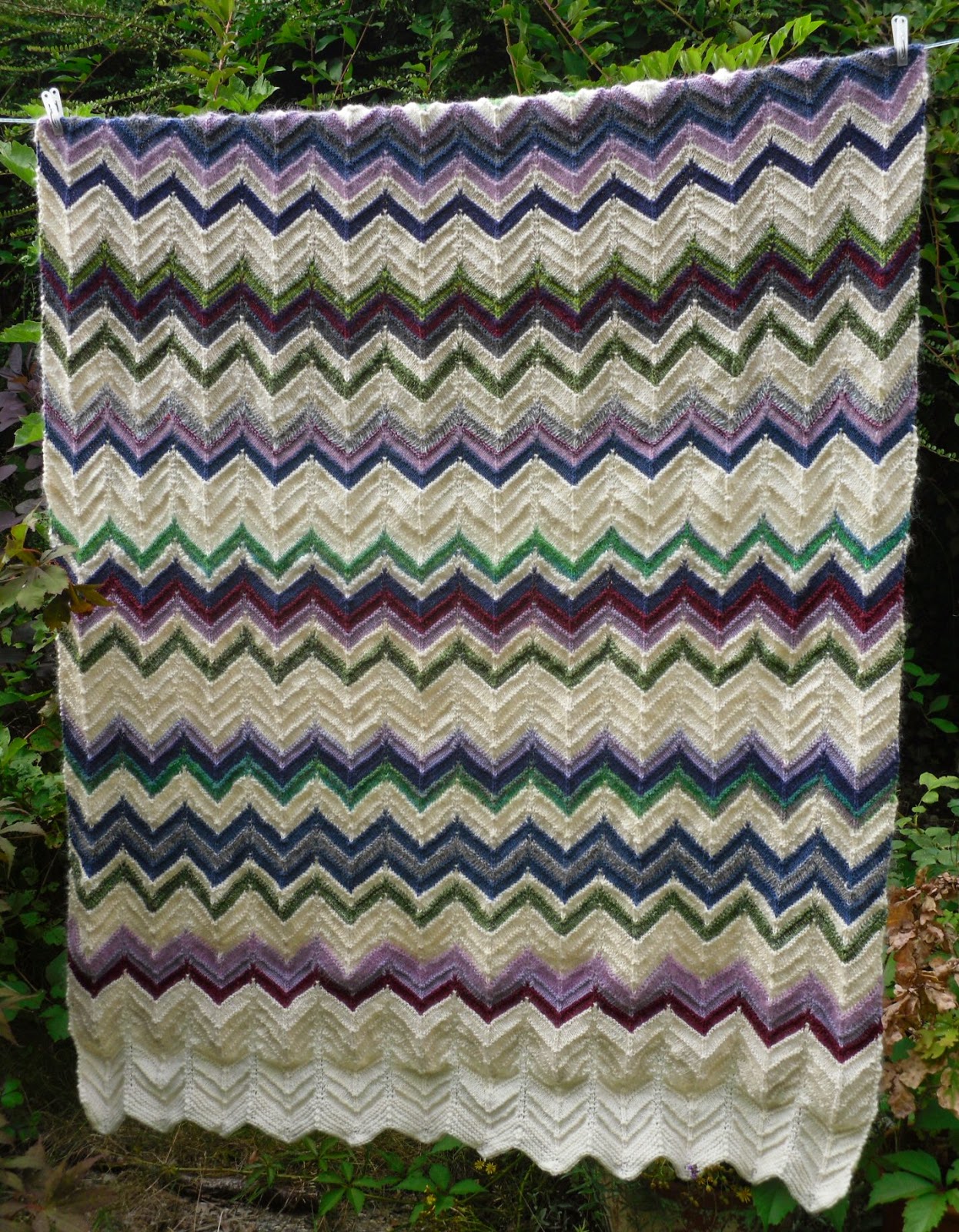
I finished a knitted blanket this week (19.08.14) which has taken a number of months to finish, using hand spun, commercial yarns, some dyed others natural. Some of the handspun is thinner than others and I used a steady needle size throughout - around 3.75, so it is quite dense in places and thin in others. There is handspun yarns acid dyed, dyed yarns using Koolaid, some commercial coloured yarn, but I guess around 60% or so is handspun. I did not spin it all, some came from table top sales with my guild and sales of leftovers by people who were having a clear-out.

The pattern is a simple zigzag stripe. I tried to spread the colours evenly across the blanket so there were no clusters of say, pink or green. It seems to have worked all right, the things is very heavy due to the denseness of the yarn and its size; although I haven't measured it, it must be around 2 m long as it is longer than I am. Folded up it will take up a fair bit of space, so it will take up a fair bit of space in my work room where I am planning to use it in the winter.

Monday, 19 May 2014

Tex 1 Project 2 stage 4 - A diversion into dyeing


Stage 4 Exercise 2 asks us to collect various threads and fabrics together on a mood and/or theme, and create colour-based bags of textile. I chose some picture postcards of works by Emil Nolde (a watercolour of lilies from his garden), and landscapes by van Gogh, Cezanne, Galle-Kallela  and Ribemont-Desaigne. Most of the colours for these are greens, greys, blues, blue-greens and in the case of Cezanne the dry Provençale earths are pale and sandy, whilst Nolde’s flowers burst with organgey tinted dark reds. This is because I am thinking about trees and natural themes for the independent project and I might as well think about this early on.
I have a fair few green and blue fabrics and threads, but thought that maybe as the day was sunny and there may be other projects to come where I can use other colours, I would do some dyeing.

Using Dylon cold water dyes in purple, yellow and a pinky red I decided to dye smaller pieces of fabrics in synthetics, silk, cotton, as well as some perlé knitting cotton, which I am planning to use for embroidery. To get a wide range of tones I started dyeing the purple. I discovered once that by adding some of the fabric after say, 10-15 minutes, a lot of the dye will have been taken from the water and any later fabric additions will be paler. This is helpful if you want a wider span of tones of a certain colour. I never weigh the fabric, I am not looking for repeatable colours and prefer to experiment. Also over-dyeing is interesting and can bring pleasant surprises.
 So, I started with the purple and the yellow. Some of the fabric was commercially pre-dyed, orange and red, and some finer fabrics a pale flesh colour. Purple on top of orange made a grizzly grimy green-brown. I am sure it will come in useful, but it does not really do it for me, it may be good later combined with yellow and other browns. Yellow on purple similarly has turned an odd greeney brown. I should have taken that out of the bath early on as the initial grey-green was quite good, but leaving it in the dye bath has meant the yellow turned it a bit too brown.
When dyeing the dark wine colour I added some yellow and purple swatches from the earlier dye baths. I also added some blue silks, and made some paler pinks later. The blue silks look great – they turned a vivid purple, and the yellows with wine have turned variations of softer wines and dark pinks. I think in hindsight I should have dyed some more yellow, as I thought that with the remaining dyes I have (two dark red/wine and a pink) that I would do some tie-dye, maybe even some shibori, so that the effect fabrics can be used for future projects. Yellow would have looked great with the red on top. 


At the end I added a synthetic doily with some embroidery on it form the 1960s-70s. Sometimes these were made with a viscose mix and I had hoped that perhaps that would have picked up the purple. It didn't really take the remainder dye, probably due to the mix of synthetics and the late addition to the dye bath.