Stage 1-2
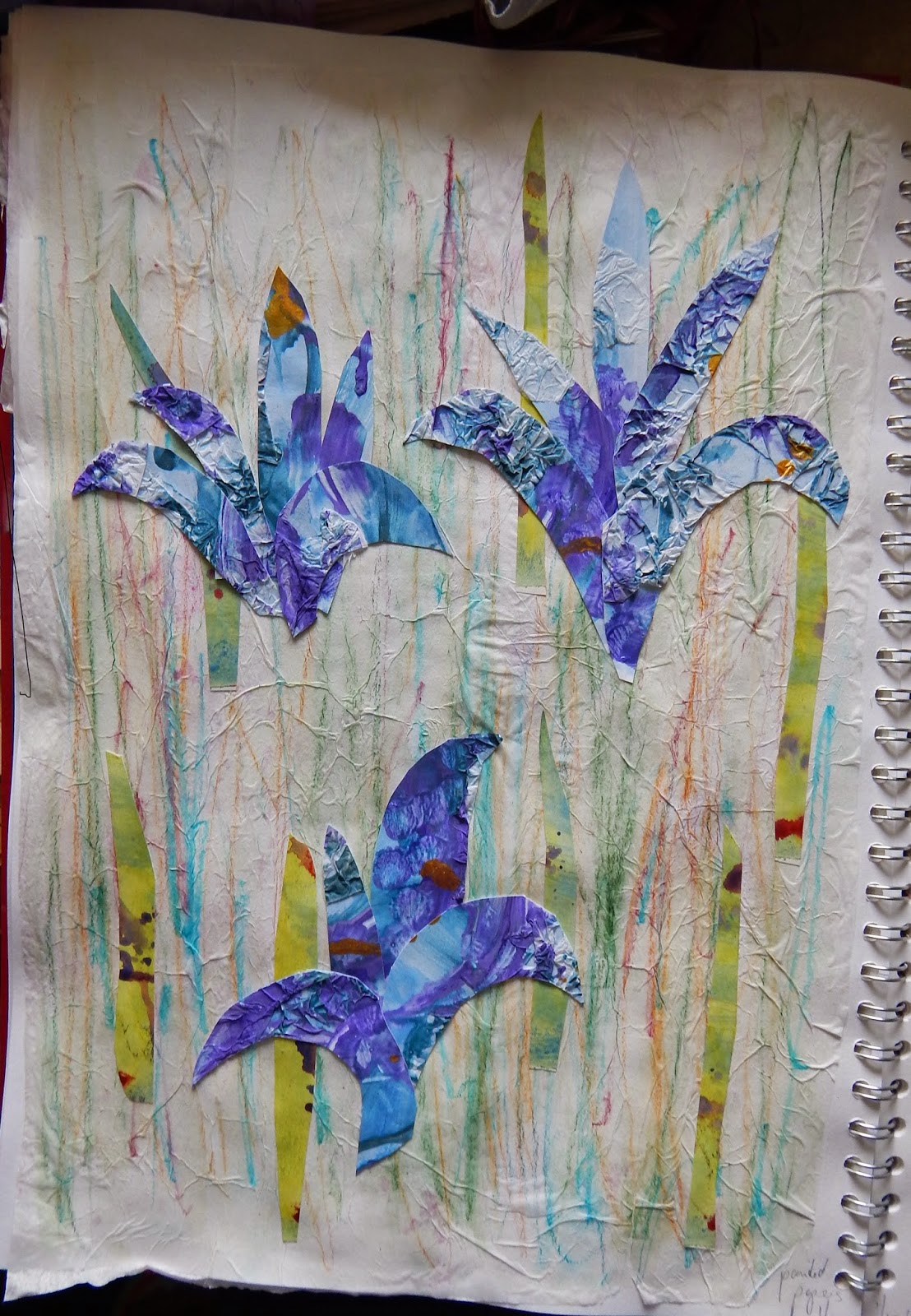
These stages are preparatory and include matching fabrics, drawing and designing. I started these in September, had a three month break and then did some collages. Please see the earlier entry for Assignment 3.
Alongside this work I also started the samples for various other stages as sampling for the work in Assignment 3is time consuming.
There is also a couple of written tasks which a kind of 'essays', which I will place in a separate post with links. My workbook will contain collages of material which I can't show here due to copyright issues.
Stage 3
Samples for applique and layering
Sandwiched fragments of silk and threads, the sample to the left on a more opaque background, the one to the right more transparent using organza and a vintage nylon scarf (which melted very easily under the iron) - using bondaweb.
Machine embroidered lacy fabric on silk and acetate
Machined snowflakes on soluble fabric then attached
A couple of samples using burning-away as a technique to disrupt the texture of the fabric - to the left black lutradur, to the right tyvek. Lutradur is a non-woven material that comes in various weights and can be burned like this to leave what is left as a lacy effect, tyvek is similarly non-woven but it bubbles up under heat and can burn away. I painted both with acrylic.
white synthetic organza I had heat-set once (part of stash I am using up) on a silver metallic fabric, sandwiched some bits of fabric with 'pearling' on the surface using stitching.
A more elaborate sample attaching three dimensional structures to a stiffened base, a cord made of silk and various paper and fabric beads (the beads are not my work, I have a wondrous charity shop that has so much good stuff). I wanted to use structured items to add to this sample and sewed everything together using freemachined zigzag stitches and large seed stitches. The idea came from Jean Draper's book, Stitch and Structure,Design and Technique in two and three-dimensional textiles, Batsford (2013)
Again appliqued fabric, a felt flower and a couple of bows, here attached by hand using buttonhole stitch and running stitch.
Stage 4 Raised and structured surface techniques
One of the samples above may also fit in this category, but actually I think that all these textile manipulation techniques are part of the same sort of idea and so it doesn't matter too much which heading they fit under.
This stage included quilting which I have done before, but it is not my thing in its traditional sense, and neither is smocking. I do admire good smocking like the heavy stitching in traditional regional farmers' smocks like the ones held by Hampshire Museum Service, and the finer work on mainly girls' dresses from the 1950s, but in general I think these techniques are probably not in my comfort zone, although it is useful to try them out.
Here are a couple of samples of pleats and tucks
Knife pleats to the left, box pleats to the right
Tucks of varying sorts, on the left some unevenly sewn ones to create shape in the fabric
A piece of synthetic lining fabric which has been randomely stitched gathered and set by heat with the iron.
Another gathering exercise here in a thick jersey (left) and a herringbone woven wool (right). I thought the wool piece was promising, in a brown tweed this might be used to evoke a tree trunk with more work. An artist who exploits fabric manipulation and has used tightly gathered strong fabrics such as denim and canvas is the Norwegian artist, Hanne Friis. Her work is on a large scale and she uses either large pieces of fabric, or assembles pieces into larger works. She uses hand sewn processes to make dynamic work that appears to move or react to the environment it is in.

A couple of heat-set pleated samples following Wolff et al's (2003) description. The white one (top) was made by running stitches pulled tightly - as in shibori preparation. The bottom sample was just piece of fabric crumpled into a ball and set in the oven. This made deep random folds. How much longevity the folds have I don't know, I am hoping that having used synthetic fabrics (I am guessing polyester based, but am not completely sure based on purchases from charity shops). Heat set synthetics are getting increasingly visible in shops used in scarves and skirts for example. Reiko Sudo, the Japanese textile designer, has taken pleating and folding of fabrics to a great level of perfection, and has produced work for the Nuno Corporation which she is a co-founder of. Examples of her work can be found on Pinterest.
Pulled thread of hessian opened up the fabric (right) and I attached it to a linen backing for firmness and to allow the yellow-green to show through.
The detail to the right of the hessian includes layering the linen background with silk paper and a silk fabric on top and I then slashed the silk and silk paper. The picture doesn't really show up the slashing as the fabrics are tonally similar, but that was intended.
A piece of firm fabric as base with layered bits of fabric covered in organza and then stitched randomely and gathered and pulled together. you need a lot of fabric for this, it pulls the fabric together. Makes for an interesting texture with a relatively deep relief structure.
A few yo-yos in a synthetic, using both front and back of fabric. This means some are shiny, whilst others are matt, quite a useful effect to think about. Thought these might have potential.
Heat set shapes moulded around small paper cups:
Quilting - a sample quilting together silk, wadding and a linen backing. I used straight machine stitch mainly, but added granite stitch (Meech, 2006) down one side. Also appliqued on two triangles to create a bit of interest in an otherwise slightly dull composition.
This sample consists of sections of gathered circles and then around some of them I did a few circles in running stitch. I thought this was quite effective, I like the linens that give the folds good shape - it is a bit like a type of smocking in the overall effect, but that was not intended.
Bubbles filled with polyester stuffing and when the circles were drawn together they caused the fabric to pleat so I sewed it down on a backing fabric with open, loose stitching. The fabric was a synthetic with heat transferred dye.
Smocking
Smocking is new to me and I did not know where to start, so I looked at Wolff's book on manipulating fabric and see that free-style smocking was more my thing so I had a go on a firm back canvas with various coloured perle yarn.
Here's the back of the sample, I quite liked that, the deep pleats make for interesting textures.
Quilting
Before doing the more traditional quilting techniques I found that Jean Draper mentions Kantha quilting in her book. I had a go assembling a piece of woollen cloth and a thin cotton with my homespun yarn, put it in the washing machine to felt it a bit and here is the result:
I know, it is probably not quite kantha quilting in its proper form and does take something from nuno felting as well as the wool obviously felts through the cotton. It was a useful exercise and the final thing is quite integrated, I think it is both a bit of constructed and manipulated techniques working with the cloth in combination with stitch and the actual substance of the fibre.
I then went on to do some traditional quilting (left) - see above. To the right is a sample that traps some buttons and a rubber ring. The ring was particularly interesting, it has pulled the fabric in a particular way and I tried to stitch the fabric down using fairly loose and random stitching.
An artist who uses this approach to quilting, trapping found objects, historical textiles and other material evocative of place, sites of memory or historical places is Diane Savona, an American quilter. She uses the surface to attach these things but then create an integrated whole that at times seem to be telling stories through the object locked into the textile - see her Garment Portraits, they include other textiles assembled and attached - the white apron ripped and placed over coloured fabric pieces (First Apron Excavation) I find interesting and also the 'Overgrown Fossil' piece is quite evocative.
This sample is made of circular shapes folded in half and then folded again with a bead and strung on a strong thread. I think this type of thing might also fit into ass. 4, but then it is also manipulated fabric of a sort, so I include it here. What was interesting about the fabric is that it is an African batik stiffened with wax, I like this it promises to have good sculptural properties.
Another sample that crosses over assignment 3 and 4. This time I cut strips of fabric, cut a piece of woven wool (a sample from my local Guild of weavers, spinners and dyers), and bits of silk overlain in places. It is an attempt at creating a very loose 'cord' (Lee(2010), Draper (2013))before this will be sewn together to create a vessel. This means the fabric manipulation side of things is in using cut strips that are folded and covered, and the 'constructed bit is the sewing together to form a new structure altogether.
The final vessel - I think this worked well, it was hard work, hard on the hands and the final vessel is quite small, useful to know if planning a bigger object in the future
The vessel upside down to show a bit more detail
And now to something that really didn't work at all; a photo of a chain I thought might make a basis for a padded chain links:
Oh dear, not a good sample - I used silvery grey organza, padded with polyester filling. Stitching on the outside edges.
The reason I don't think this one worked is how clumsy it is. Dimensions are wrong, the translation from hard iron to soft fabric didn't work and the original image would have worked much better as a source for a flat design, repeat or some other 2D rendering.
Final sample - manipulated fabric
The last piece in this project is to make up a design based on a drawing from an earlier stage. I quite liked the crumpled paper that I used as a backdrop for some collages, and since I also liked the heat set fabrics, I went all the way and assembled some of these.
First the collage, and some detail:
A dried-up plant dropped its leaves and these also suggested surface pleats and folds:
So, here are the building blocks of what I assembled - heated up, ironed and painted/unpainted tyvek, iron heated polyester and oven-heated polyester. The fabric was leftovers from the printing projects in assignment 2.
On this detail I really liked the top right piece, which is a randomly gathered piece heat set with the iron. All of it needed to be sewn onto a firm backing fabric as the polyester is quite slippery.
The course book says we should not sew anything onto this sample. Although the effects work on this sample, the totality needs to be tied better together to unify everything, and in the end a line crossing all will help - so I am sewing on a piece of cotton string painted blue. So here's a 'before' picture with the blue string being attached:
The final piece with the string applied and a few beads
References
Draper, Jean, 2013, Stitch and Structure: Design and Technique in two and three-dimensional textiles, London: Batsford
Lee, Ruth, 2010, Three-Dimensional Textiles with Coils, Loops, Knots and Nets, London: Batsford
Meech, Sandra, 2006, Contemporary Quilts: Design, Surface and Stitch, London: Batsford,
Wolff, Colette et al, 2003, The Art of Manipulating Fabric, Krause Publications